

%20STM%20AGENCY%20blog%20header.jpg?width=1408&height=704&name=Universal%20Commerce%20Protocol%20(UCP)%20STM%20AGENCY%20blog%20header.jpg)
Google has quietly dropped something pretty big. It’s called Universal Commerce Protocol (UCP), and while the name sounds technical, the idea behind it is actually very simple: make buying things inside AI-driven experiences easy, consistent and secure.
If you’re already keeping an eye on AI search and how search is changing, this is one of those moments worth paying attention to.
In this blog, we break down what Universal Commerce Protocol (UCP) is and what this means for search and the future of online shopping.
What is Universal Commerce Protocol (UCP)?
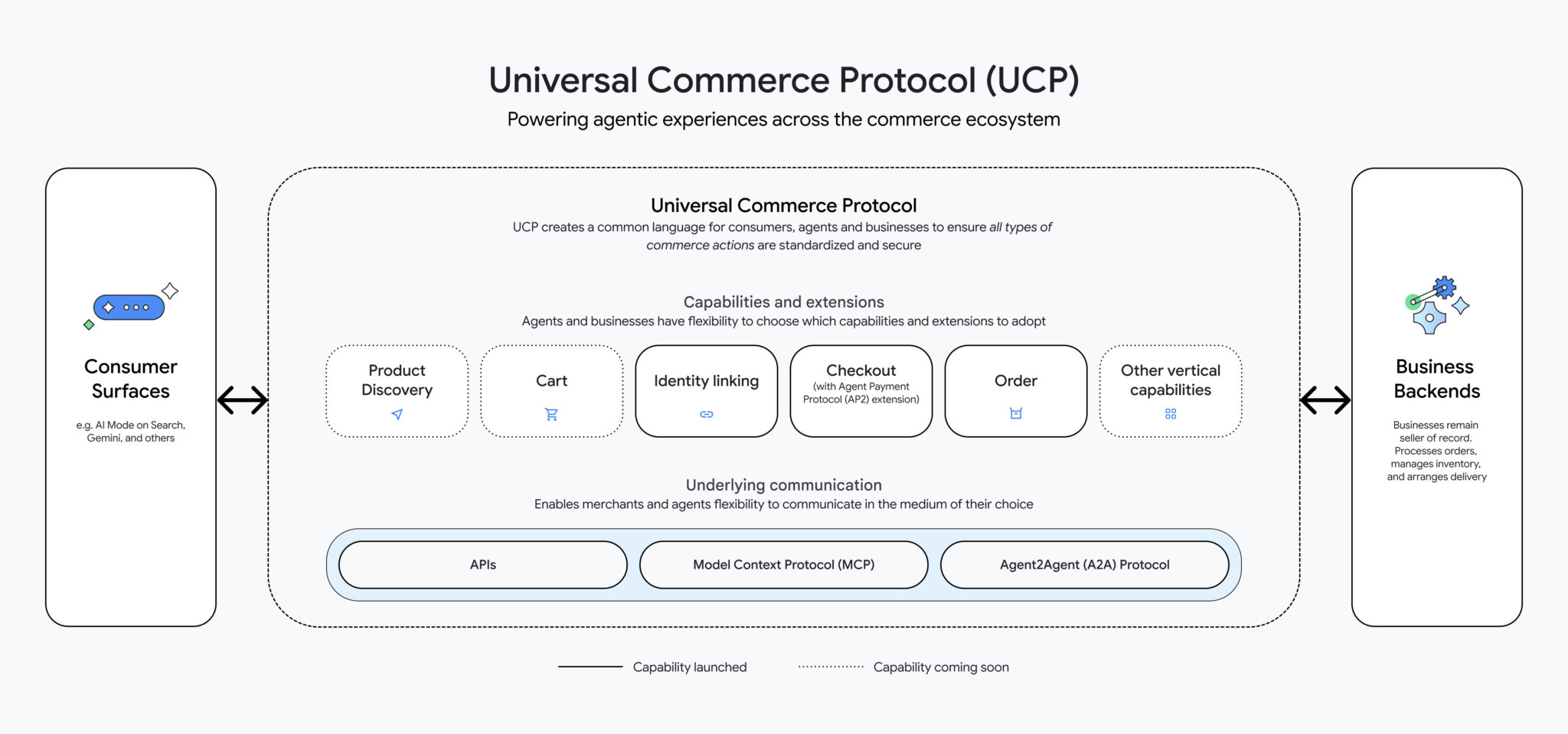
Universal Commerce Protocol (UCP) is a new open standard from Google designed to help AI systems understand how to buy things on behalf of users. Think of UCP as the new “universal translator” between AI agents and e-commerce platforms.
Instead of AI tools just showing product links and sending people off to websites, UCP gives them a shared way to:
- Understand product availability
- Check prices and delivery options
- Complete payments
- Confirm orders
All without needing bespoke integrations for every retailer.
Co-developed with heavy hitters like Shopify and backed by the likes of PayPal, Walmart, and Target, UCP is the framework that allows AI and AI agents to handle the entire shopping journey - from finding the perfect product to hitting the "buy" button - without ever leaving the chat interface.
UCP isn’t the only thing Google announced
What Google really made clear is this: shopping is being rebuilt directly inside AI experiences, not bolted on later. Here’s what else is coming.
A smarter shopping experience inside AI and Search
Google is significantly upgrading how shopping works inside AI Mode, Gemini and Google Search itself.
Instead of AI just pointing people to products, it will help users explore options, compare choices and move closer to a decision - all without leaving the experience. Search becomes less about links and more about guidance, which is a big moment for AI search, SEO and Answer Engine Optimisation (AEO).
Business Agent: a virtual sales assistant in Search
One of the most interesting updates is Business Agent - a branded AI assistant that lets users chat directly with retailers inside Google Search.
Think of it as a virtual sales associate that:
- Answers questions in the brand’s own tone of voice
- Helps at high-intent moments, when someone is close to buying
- Reduces friction by keeping the conversation in one place
Direct Offers: advertising meets intent
Google is testing Direct Offers, a new Google ad pilot designed specifically for AI Mode. When Google’s AI detects that someone is close to making a purchase, brands can surface timely incentives such as:
- Exclusive discounts
- Bundles
- Free shipping
- Other value-led offers
This is a shift away from generic ads towards context-aware, intent-driven promotion, which will change how paid media and organic strategies work together.
So, what does UCP mean for the future of online shopping?
This is the bit that matters. UCP is Google accepting that people won’t always:
- Visit 10 websites
- Compare tabs
- Scroll endlessly
Instead, more users will say something like: "Find me a waterproof running jacket under £100 and buy it using my saved card," and the AI will do exactly that.
UCP makes that possible by giving AI agents a structured way to move from recommendation → purchase → confirmation without friction.
For brands, it means:
- Less emphasis on getting the click
- More emphasis on being the best and most relevant answer
No more jumping through multiple tabs or re-entering shipping info several times. It’s a "one-click" world, but powered by conversation.
The benefits of UCP
UCP presents a huge opportunity to reduce friction when it comes to online shopping. Here’s why Google (and others) are pushing this.
For consumers
- Faster buying decisions
- Less effort switching between sites and platforms
- More confidence that payments and delivery are handled properly
For retailers
- Reduction in cart abandonment
- Fewer custom integrations to maintain
- Easier participation in AI-driven shopping journeys
- Remain the Merchant of Record
- Potential access to customers earlier in the decision process
For the wider ecosystem
- A shared standard instead of dozens of closed systems
- More consistent and secure commerce experiences
- A foundation for future AI-led shopping tools
Overview of how it works (The non-techy version)
Instead of an AI "looking" at your website, it "talks" to your store’s backend.
1. A user asks an AI tool to help them buy something2. The AI looks for products that match the request
3. Using UCP, the AI can:
a. Check stock
b. Confirm pricing
c. Understand delivery options
d. Handle payment securely
4. The order is placed and confirmed
5. The retailer fulfils it as normal
Behind the scenes, UCP standardises the “buying” steps so AI tools don’t need a custom setup for every store.
How it integrates with Google
This is where things get interesting for marketers. UCP is designed to sit naturally alongside Google’s wider ecosystem, including:
- AI Mode in Google Search
- Gemini app
- Conversational search experiences
- Shopping integrations
- Merchant and payment systems
If your products are in Google Merchant Center and you’ve opted into the protocol, your items won't just appear as a link, they’ll appear as a buyable option.
This makes Generative Engine Optimisation (GEO) and Answer Engine Optimisation (AEO) more important than ever. It’s no longer just about ranking #1; it’s about having the most accurate, structured data so the "Answer Engine" can confidently recommend and sell your product.
What this means for SEO, GEO and AEO
Traditional SEO has focused on:
- Keywords
- Rankings
- Click-throughs
UCP accelerates a world where:
- AI summarises options
- AI recommends products
- AI completes actions
That means your product content needs to be:
- Clear
- Structured
- Trustworthy
- Easy for AI to understand
This is where Generative Engine Optimisation (GEO) and Answer Engine Optimisation (AEO) really come into play. Think:
- Strong product descriptions
- Accurate specs
- High-quality imagery
- Clear pricing and delivery info
- Consistent brand signals
If the AI can’t confidently explain why your product is the right choice, it won’t surface it.
In summary
The arrival of UCP and agentic shopping marks the start of another major shift in how people discover, decide and buy online.
It points to a future where:
- Shopping happens inside AI-driven experiences
- Search becomes more conversational and intent-led
- SEO evolves into GEO and AEO
- Brands compete on clarity, quality and trust - not just visibility
As AI takes on more of the decision-making, purchase moments will increasingly happen before someone reaches a retailer’s website. Influence moves upstream, into high-intent conversations happening inside AI-powered discovery rather than traditional search ads alone.
We already know traditional SEO is evolving into something far more interactive. To stay ahead, brands need to focus on strong product data, clear value signals and genuinely helpful, AI-ready descriptions.
Share Article


.png?width=704&height=396&name=Why%20paid%20social%20creative%20needs%20an%20engine%20feat%20image%20(1).png)