STM Agency
Published
13 Oct 2026
Share Article


Earlier this year, we explored how Meta's move towards AI-led advertising was changing the role of creative. The big takeaway was simple: targeting has not disappeared, but the creative itself is now doing much more of the work.
Since then, further evidence has underlined just how important creative has become. Segwise recommends running eight to 12 genuinely distinct creative concepts in a campaign and refreshing them every two to three weeks. It reports that accounts following this approach have achieved 20% to 35% higher return on ad spend than those using more traditional campaign structures.
Meta’s advertising system now uses the content and format of an ad to match it with the people most likely to respond. Its Andromeda retrieval engine narrows millions of possible ads down to a smaller group of candidates before the final ranking and auction stages take place.
So, the question is no longer: “Who should see this ad?” Increasingly, it is: “Which ad should this person see?”
Giving the platform a purposeful mix of ideas, messages and formats creates more opportunities to connect with different people, needs and moments. But this is not about producing endless ads. It is about having a repeatable way to develop, test and improve genuinely different creative.
That is why we built our Paid Social Creative Engine.
Why creative has become one of the biggest performance levers
For years, paid social teams could improve results by refining audience definitions, building complex account structures and making frequent campaign adjustments.
Those skills still matter, but automation is taking on more delivery decisions. As platforms gain greater control over audience expansion, placement selection, budget distribution and the creative variation shown to each person, the quality and range of the inputs we provide become more important.
Creative can no longer sit at the end of the planning process as a list of assets available. It needs to be part of the media strategy from the beginning.
That means considering the different reasons someone might care about a product or service. What challenge are they trying to solve? How familiar are they with the brand? What would help them understand the offer, and what evidence might give them the confidence to act?
Yet many campaigns still expect one piece of creative to do every job. One message is stretched across the customer journey. One image is resized for several placements. A small copy change is treated as a new test.
More files do not automatically create more useful variety. Three versions of the same idea are still one idea.
A genuine creative system connects the campaign objective, audience mindset, message, format and measurement approach. Every asset has a role and is designed to help us learn something, rather than simply filling a space in the media plan.
What genuine creative variety looks like on Meta
On Meta, creative now acts as a powerful signal about who an ad may be relevant to. This means advertisers need to become more rigorous about the range of ideas they give to the platform.
Creative variety can come from several places...
For video, it might mean leading with different hooks in the opening two or three seconds to explore what captures attention and earns the next few moments of viewing.
For static creative, it could mean testing genuinely different message angles, customer challenges or product benefits, rather than simply changing the headline or background colour.
Variety can also come through visual treatment. A graphic-led execution may communicate a benefit quickly and clearly, while lifestyle or photography-led creative can help the audience picture the product or service in a more recognisable context. Creator and influencer content may bring a different voice and level of credibility to a campaign, while brand-owned creative can provide consistency, authority and control.
Different audience mindsets should be considered too. The same product might solve several challenges or appeal to different motivations. Each of those offers a distinct creative route and a new way for the platform to connect the message with the right person.
The format matters just as much as the idea. Stories, Reels, feeds and carousels are different viewing environments. A creative concept designed for Stories might use pace, movement and a direct opening, while a carousel could reveal the idea progressively or allow someone to explore several features and proof points.
The central idea can stay consistent, but the way it is expressed should feel natural to the placement and to how people behave there.
This is the difference between creative variation and cosmetic versioning. Changing a crop, colour or line of copy can be useful, but it rarely introduces a new reason for someone to engage. A different hook, mindset, message angle, visual approach or source of proof can.
Creative planning cannot stop at launch either. Even a strong ad can lose impact once the most responsive audience have seen it repeatedly. A good system needs to include a plan for learning and refreshing, rather than waiting for performance to decline before rushing to produce replacements.
The same principle applies to LinkedIn, but the creative should not look the same
Although the recent conversation has been dominated by Meta, the same overall principles apply to LinkedIn, but that does not mean the creative should look or behave in the same way.
People often use LinkedIn in a more professional and evaluative mindset. They may be researching a challenge, looking for a useful point of view or considering solutions that could affect their organisation. Creative therefore needs to earn attention through credibility, relevance and value.
The platform also offers formats suited to that mindset. Document Ads can give someone useful content to explore in-feed, while Lead Gen Forms reduce friction by automatically populating professional profile information.
LinkedIn lets you sync those leads into CRM and marketing platforms and provides reporting on form completion and cost per lead.
The lesson is not that one format always wins. It is that the format, message and objective need to work together.
A short video designed for fast, passive viewing on Meta may need a different opening, pace and proof structure on LinkedIn. Equally, a detailed thought leadership asset designed as a Document Ad is unlikely to translate directly into an effective Reel.
The creative engine can be shared, but its output should reflect the audience mindset and behaviour on each platform.
What WHOOP’s creative volume can teach us
WHOOP provides a useful example of what systematic creative variety looks like in practice.
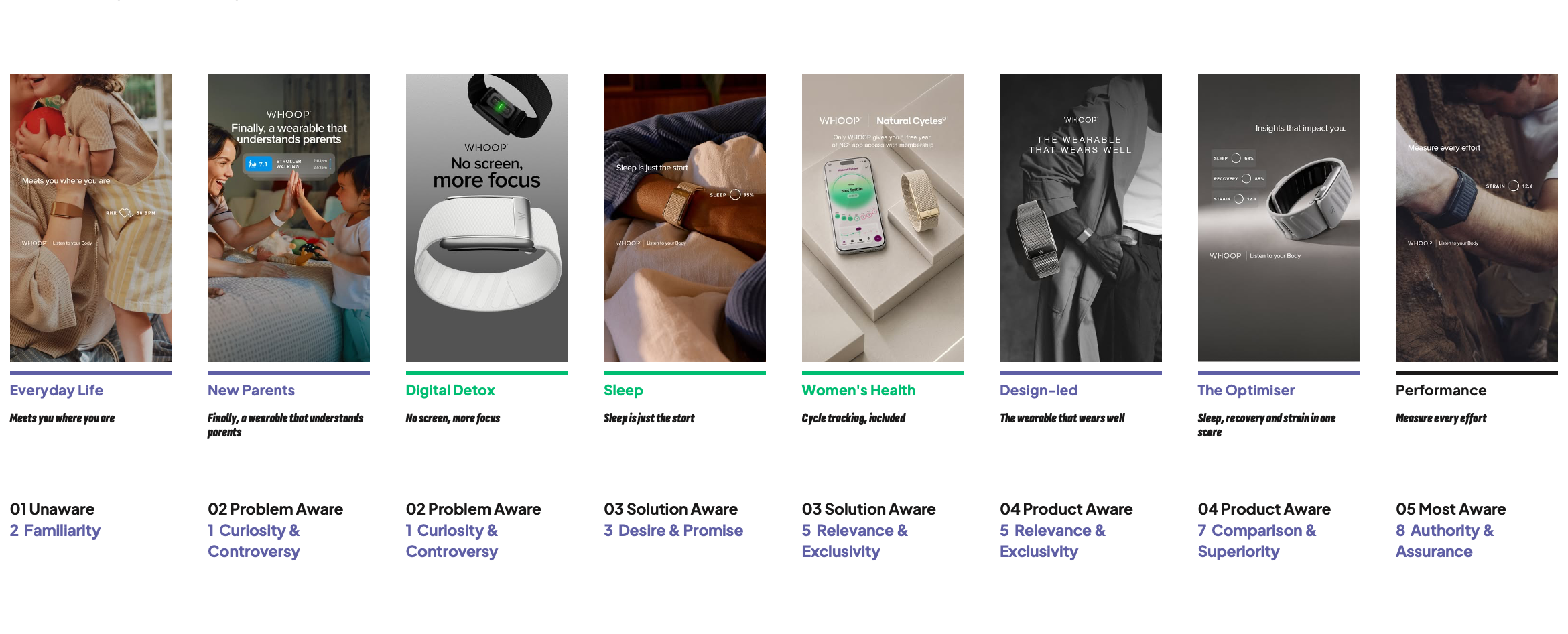
When we analysed its advertising activity for our Creative Engine, we identified 1,675 creatives in its wider library, around 14 new ads being introduced each week and more than 20 distinct angles around a single core product. At the time of that analysis, 282 ads were live.
The interesting point is not simply that WHOOP produces a lot of ads. It is that the creative approaches the same product from genuinely different directions.
The wearable can be framed around sleep, performance, everyday health, product design, focused living or the needs of a particular customer group. Different messages, visual treatments, formats and voices create more opportunities for the product to feel relevant.
That is creative volume with a purpose. It does not mean every advertiser needs hundreds of live ads. Creative volume should always be proportionate to the campaign budget, audience size and amount of data available.
The more useful lesson is to treat creative as a portfolio rather than a one-off deliverable. Some ideas will capture attention. Others will explain the offer, introduce a use case or provide the proof someone needs to take the next step. A small number may become clear winners that deserve further investment.
Without meaningful variety, it is difficult to tell whether a campaign is struggling because of the offer, the execution or simply the angle chosen at the beginning.
Building creative for how platforms now work
It is easy to frame today’s creative challenge as a need to make more content, faster. That is only part of the story.
The bigger opportunity is to connect strategy, creative and media more closely. Paid social teams should not receive finished assets without context. Creative teams should not be asked for another batch of ads without access to performance learning. And brands should not have to choose one preferred execution before the audience has had an opportunity to respond.
A creative engine replaces that stop-start process with a more connected way of working. It starts with the campaign objective and a clear understanding of the audience. It creates purposeful variety, adapts ideas to different platforms and placements, and uses performance data to shape what comes next.
This shift is also changed the way we approach creative sprints here at STM Agency.
Rather than developing several competing campaign routes, we now focus on building one strong campaign platform and bringing it to life through different creative expressions, designed for the audience, channel and moment.
This gives brands greater variety without losing cohesion. It also helps combat creative fatigue, extend campaign longevity and keep content relevant for longer. More importantly, it creates a clearer connection between the original strategic idea, its different executions and what performance tells us to do next.
The platforms may now make more of the delivery decisions, but marketers still decide what goes into the system. That makes the brief, the creative strategy and the learning process more valuable, not less.
If your campaigns are still relying on one hero concept, repeated resizes or last-minute refreshes, we can help you build a more connected creative approach.
Speak to our team about creating a paid social creative engine and evolved sprint process can create purposeful variety, generate stronger learning and drive better advertising performance outcomes for your brand.
Share Article
.png?width=704&height=396&name=Why%20paid%20social%20creative%20needs%20an%20engine%20feat%20image%20(1).png)