

STM Agency
Published
30 Jul 2026
Share Article


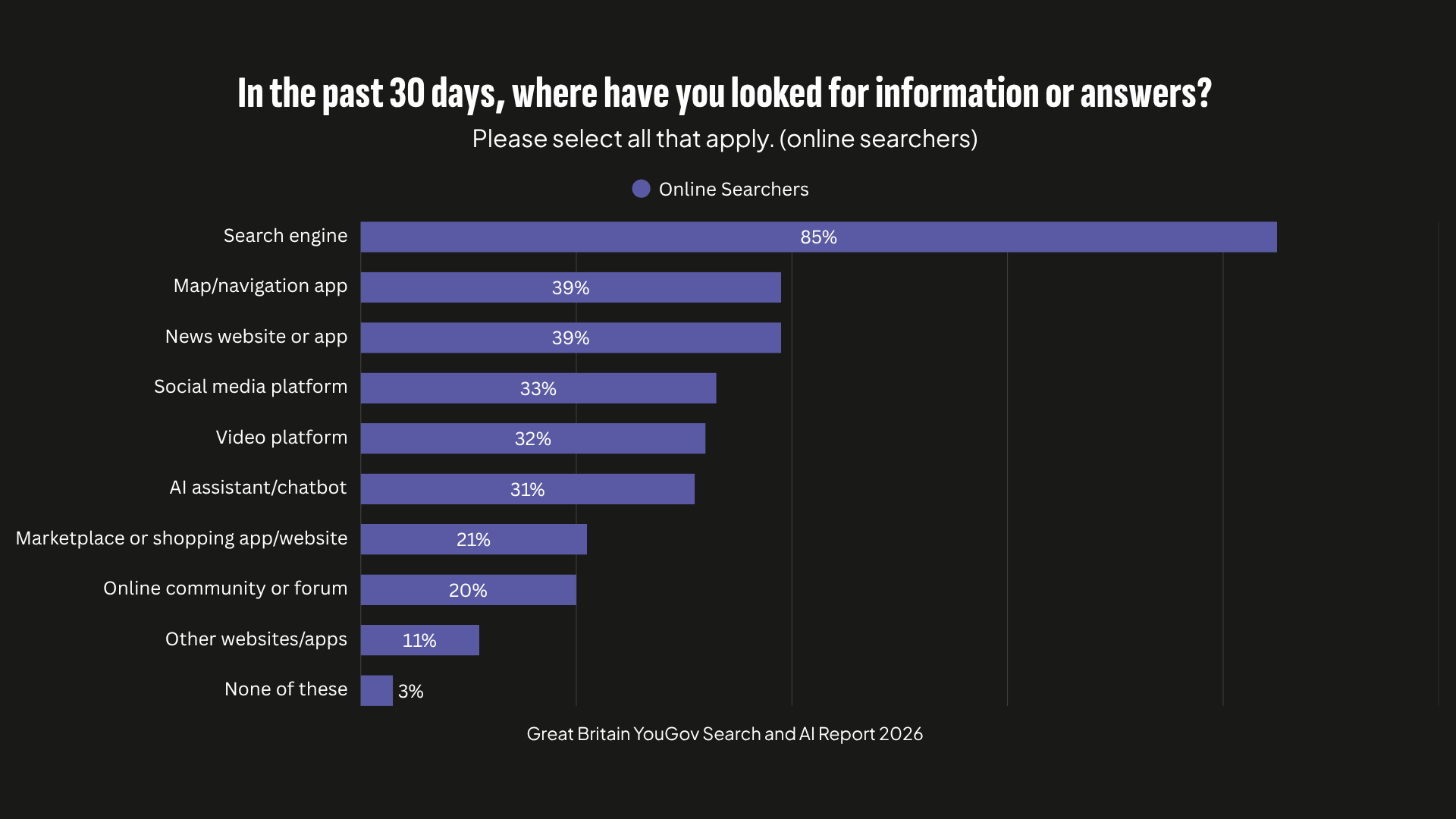
85% of British online searchers still used a search engine in the past 30 days. But 33% also turned to social media, 32% to video platforms and 31% to an AI assistant or chatbot.
That tells us something important about the state of search in 2026. Traditional search is not disappearing. Far from it. But the way people discover, research and make sense of information is becoming much more fragmented.
We are moving from a world where ‘search’ largely meant opening Google and typing into a search box, to one where people move between multiple platforms- search engines, social platforms, video, maps, marketplaces, forums and AI assistants depending on what they are trying to achieve.
And as AI becomes embedded within those experiences too, the lines between search, discovery and decision-making are becoming increasingly blurred.
New YouGov research into online search behaviour across Great Britain gives us a clearer picture of what that shift actually looks like, and what it means for brands trying to stay visible.
Data source: YouGov’s Great Britain Web Search and AI Report 2026
Search has become a continuous behaviour
Nearly two-thirds of Brits now look for information online every day, according to YouGov. Almost a third do so six or more times a day, rising to 43% of Gen Z, 40% of Millennials and 45% of higher-income consumers.
Search is no longer something people necessarily sit down and consciously decide to do. It is woven into everyday life.
We search while shopping. While watching TV. On the train. During meetings. While comparing a product someone has mentioned. When checking whether something we have just seen on social media is actually true.
That constant cycle of discovering, researching, comparing and validating means brands have more potential opportunities to be found, but those opportunities are spread across a much wider ecosystem.
While 85% of British online searchers used a traditional search engine in the past month, sizeable audiences also searched through maps and news platforms at 39% each, social media at 33%, video platforms at 32% and AI assistants at 31%.
So, the story here is not that people have stopped using Google. It is that Google is no longer the only place we should think about when we talk about being ‘discoverable’.
People are choosing the platform that best fits the task or question
One of the most interesting findings from the YouGov research is how much search behaviour now changes according to the task.
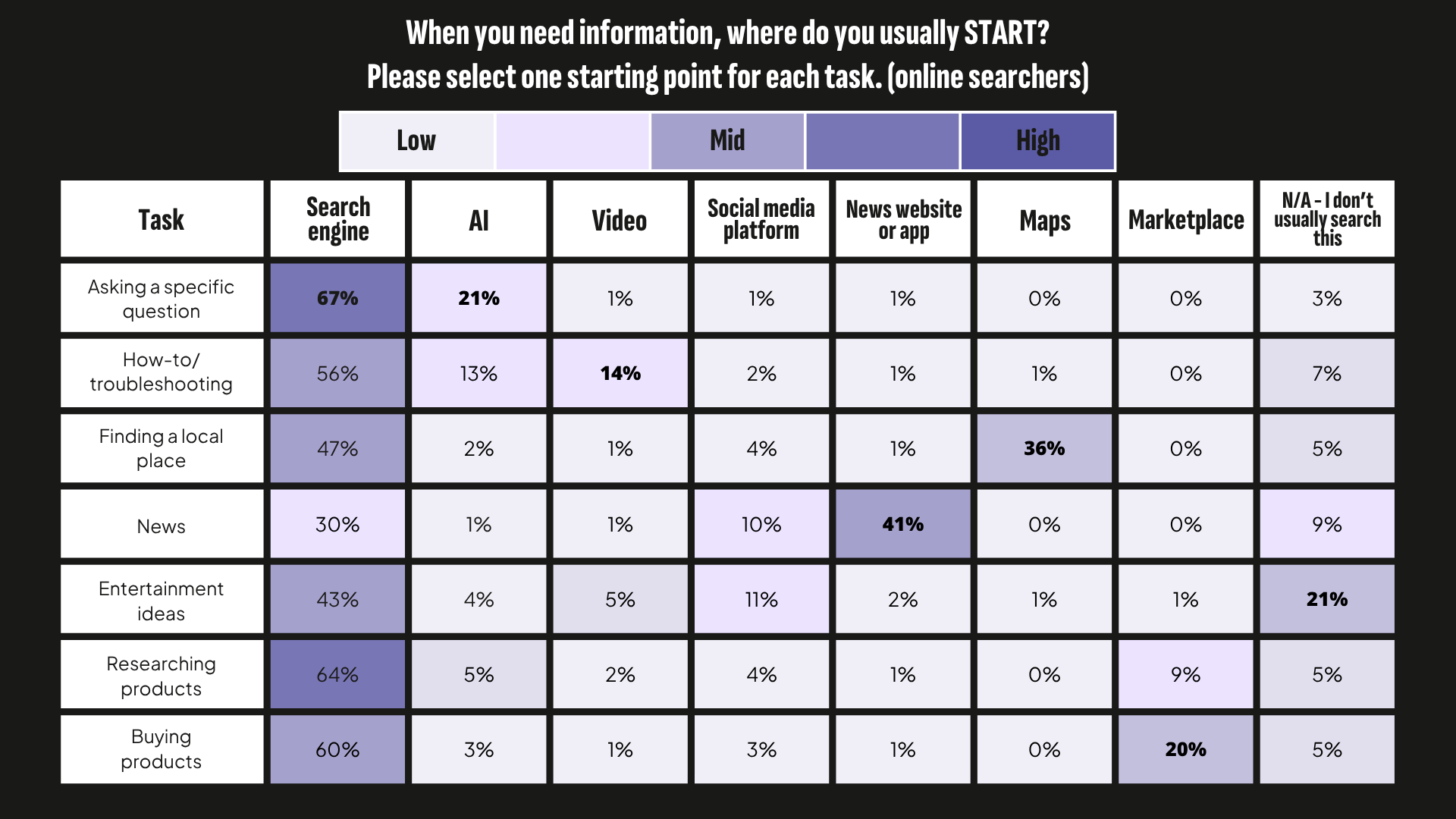
When asking a specific question, 67% of online searchers still start with a search engine, while 21% start with AI. For how-to and troubleshooting queries, search engines lead at 56%, but video platforms and AI assistants also play significant roles.
When someone wants to find somewhere local, maps become much more important. For news, dedicated news platforms take a bigger role. And when looking for entertainment ideas, 21% say they do not actively search at all.
That last point matters. Not all online discovery begins with a query. Sometimes the answer finds us first – through a TikTok recommendation, a YouTube video, an Instagram post, an algorithmic feed or a creator we follow.
Search, therefore, increasingly sits somewhere between active intent and passive discovery.
Younger audiences are already demonstrating what this richer search ecosystem looks like. YouGov found that 49% of Gen Z online searchers had used social media to find information in the previous 30 days, 45% had used video platforms and 37% had used online communities or forums.
Interestingly, Millennials were the generation most likely to have used an AI assistant, at 42%, compared with 35% of Gen Z.
That suggests AI adoption is not simply a story about the youngest generation chasing the newest technology. It is also about utility. For busy consumers balancing work, family and increasingly complex digital lives, anything that can help process information or reach an answer more quickly has an obvious appeal.
The implication is clear: your audience does not have one search journey anymore.
AI is becoming a search companion, not a search replacement
YouGov's findings also challenge the idea that consumers are about to abandon traditional search altogether.
More than half of online searchers say they at least sometimes start new queries using an AI assistant. Among existing AI searchers, 71% say they use AI to find information more than they did a year ago.
Once AI becomes useful within someone's workflow, it appears to become increasingly sticky. But adoption is not uniform.
Just 12% of people who currently do not search with AI expect to increase their use over the next year, while 59% do not expect to start at all. By comparison, 46% of existing AI searchers expect their use to increase, rising to 62% among frequent users.
In other words, the immediate shift may be less about converting everyone into an AI searcher and more about existing users becoming much heavier users. And even among those users, AI rarely exists in isolation.
Only 15% describe AI as their main starting point when looking for information. More commonly, people use it alongside other sources, after another search or for specific questions.
That makes the idea of ‘traditional search versus AI search’ increasingly unhelpful. AI is becoming another layer within the journey.
The products themselves are starting to reflect that convergence. Google now allows users to move directly from an AI Overview into a conversational AI Mode experience while retaining the context of their original search. Google also says AI Overviews now have more than 2.5 billion monthly active users and AI Mode has surpassed one billion.
Search engines are becoming more conversational at the same time as AI assistants are becoming better at finding and referencing information from the wider web. The two experiences are moving closer together.
AI's biggest impact may be on decision-making
There is another important distinction in the YouGov findings. AI is not only helping people find information. Increasingly, it is helping them process it.
Among AI searchers, 54% use assistants to get direct answers. But 34% use them to summarise information, 28% to verify something they have found elsewhere, 25% to compare options and 24% to troubleshoot a problem. That changes the role brands play within search.
Historically, search engines have been particularly good at helping people locate information. AI is becoming particularly useful when people already have information but need help understanding, comparing or evaluating it.
Think about someone planning a holiday. They might discover a destination through Instagram, search Google for hotels, watch YouTube reviews, visit several travel websites and then ask an AI assistant to compare their options.
Or someone buying a high-consideration product might read reviews, visit retailer sites and research specifications before asking AI to summarise the differences.
In these journeys, AI may not create the initial discovery moment at all. But it can have considerable influence over what happens next.
That is why we increasingly see AI search visibility as an influence channel as much as a referral channel. A brand being accurately represented, recommended or cited within an AI answer can shape a later Google search, website visit or purchase decision even when the AI platform itself generates no measurable click.
Trust remains the biggest barrier to AI search
Speed and convenience are important, but when the stakes rise, so does the need for reassurance.
Only 31% of British online searchers say they trust information from AI assistants, compared with 77% for search engines. Trust rises significantly to 49% among people who already use AI for search, suggesting familiarity is helping users become more comfortable with the technology.
But even regular AI users do not simply accept every answer they receive. After receiving an AI-generated answer, 22% of AI searchers most commonly click through to the links provided and another 22% compare the information with other websites or apps. Among frequent AI searchers, 29% usually click through to an AI-supplied source.
AI may be reducing the effort involved in understanding information, but it is not removing the need for trustworthy information in the first place, making authority increasingly valuable.
YouGov found that official sources, clearer explanations of how an answer was reached and visible links to sources can all help build confidence among AI users. However, there is no simple solution for everyone: 37% of non-AI searchers said none of the tested trust features would increase their confidence.
Trust will therefore be earned over time, through consistent accuracy, transparency and the quality of the information being surfaced.
For brands, that means the goal should not simply be to ‘get mentioned by AI’. It should be to become a source that both people and AI assistants have good reason to trust.
What does the data tell us in a nutshell?
The biggest mistake brands could make now is developing an AI-only search strategy. The evidence simply does not support it.
Search engines remain central. Social and video are increasingly searchable. AI assistants are growing in importance. And consumers are moving freely between all of them.
Rather than optimising for one platform or channel, brands need to think about how they are found, understood and trusted across the whole search ecosystem.
Build visibility beyond your website
Your website is still fundamental, but search visibility increasingly extends into the wider content ecosystem around your brand.
Google's latest Search Console update makes that shift particularly tangible. Its new platform properties allow brands and creators to see how Instagram, TikTok, X and YouTube content is being discovered through Google Search and Discover.
That is a significant signal. Search strategy can no longer sit completely separately from social, video, PR and content strategy. The content you publish elsewhere can influence how consumers discover your brand – and how search engines and AI systems understand it.
Make your expertise easy to understand and verify
Semrush points to increasingly conversational and complex AI search behaviour, where users ask detailed questions and expect synthesised answers rather than a simple list of links. That increases the importance of content that communicates its meaning clearly, answers genuine questions and provides credible evidence.
This does not mean writing robotic content ‘for AI’. Google's own guidance is clear that the fundamentals of good SEO still underpin visibility within its generative AI experiences. Valuable original content, technical accessibility and a strong user experience remain central, and there is no special AI markup or shortcut required.
The brands most likely to stand out will be those creating content with something genuinely useful to say: original research, expert opinion, first-hand experience, strong case studies and clear answers backed by evidence.
Stop measuring visibility through clicks alone
Ahrefs' latest research found that the presence of a Google AI Overview correlated with a 58% lower average click-through rate for the top-ranking page in its study. At the same time, YouGov's research shows that AI users may continue their journey by comparing sources or searching elsewhere rather than immediately visiting the original website.
That means brands need a broader view of search performance. Rankings, traffic and conversions remain important, but so do impressions, brand mentions, AI citations, share of visibility, branded search behaviour and assisted journeys.
Measurement is beginning to catch up. In June, Google introduced dedicated Search Console reporting for visibility within generative AI features such as AI Overviews and AI Mode, before extending Search Console reporting to social and video platform content in July. Visibility is becoming bigger than the click.
The future of search is an ecosystem, not a winner-takes-all battle
The most important takeaway from the YouGov research is that the future of search is unlikely to come down to consumers choosing between a search engine and an AI assistant. They are already choosing both.
They are also choosing social platforms, videos, maps, marketplaces, communities and increasingly whatever interface can give them the most useful answer for the task in front of them. And the next phase will make those boundaries even less distinct.
Search engines are becoming conversational. AI assistants are becoming research tools. Social and video content are becoming more searchable.
Emerging AI agents are beginning to move beyond providing answers towards comparing options and carrying out tasks on a user's behalf.
Google itself is now advising site owners to prepare for these emerging agentic experiences alongside traditional and generative search; creating more complexity but also more opportunities to be discovered.
How we can help
Our approach to AI search visibility looks beyond rankings alone to understand where your brand is being discovered, how it is being represented and whether it has the authority to be surfaced, cited and chosen across an increasingly complex search ecosystem.
Not sure how visible your brand really is across Google, AI assistants, social and the wider search ecosystem? Let's change that. Get in touch to find out how we can help your brand get found, understood and chosen.
Share Article