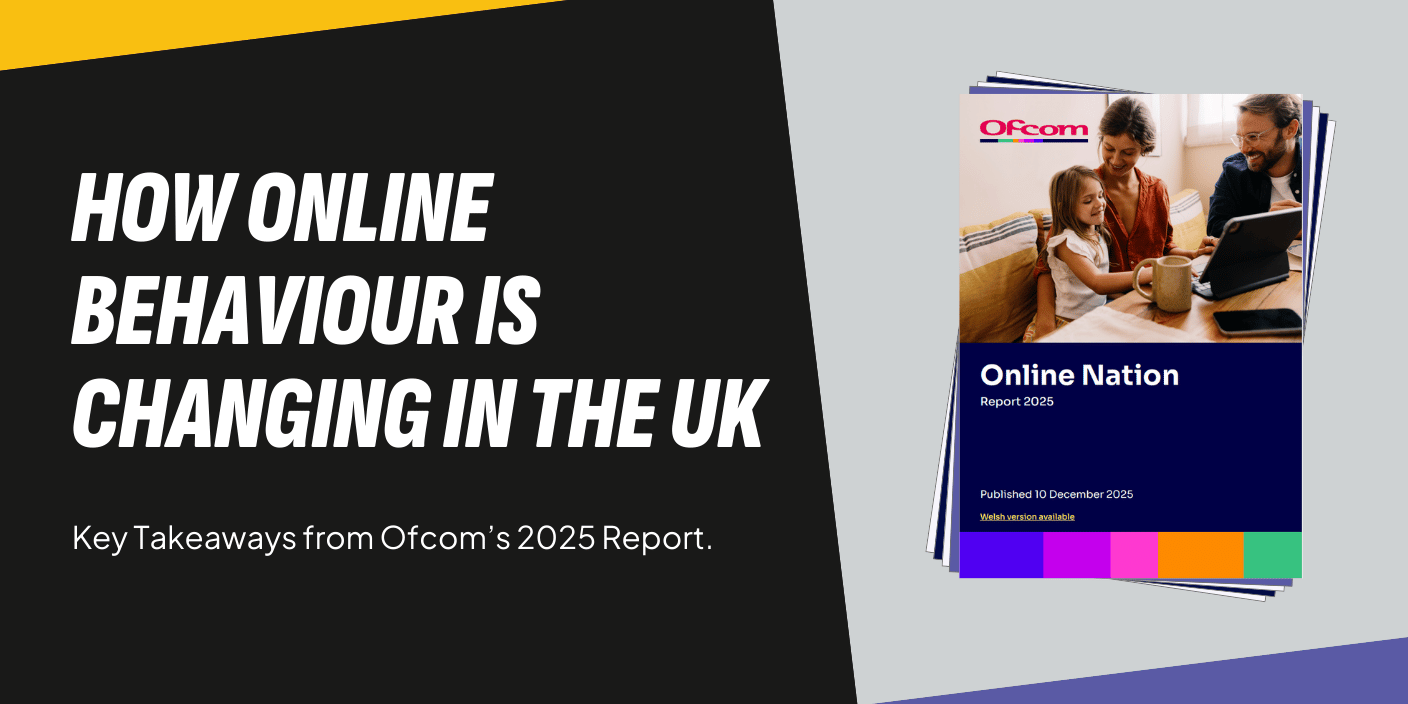
Every year, Ofcom’s Online Nation report gives us one of the clearest pictures of how people in the UK are really spending their time online and the 2025 edition confirms a shift we’re seeing across client work, campaigns and platforms.
From rising screen time and changing social behaviours to the growing influence of community-led platforms and AI-powered search, this year’s report highlights how digital habits continue to evolve and why brands need to adapt fast.
Here’s our breakdown of the key insights...
Online time is still rising - and mobile leads the way
UK adults now spend 4 hours and 30 minutes online every day, up 10 minutes year-on-year. Young adults (18–24) remain the most digitally engaged, clocking over 6 hours a day, while even the 65+ audience has increased their time online.
Unsurprisingly, smartphones dominate. Nearly 80% of online time happens on mobile, reinforcing a simple truth for brands: If your content, ads or landing pages aren’t built mobile-first, you’re already on the back foot.
What this means for brands
- Mobile-first creative and UX isn’t optional
- Shorter attention spans demand clearer messaging, faster loading and stronger hooks
- Paid and organic social need to work together to capture fragmented attention
A few big platforms still dominate - but attention is fragmenting
Over half of all time spent online is still owned by Meta and Alphabet. YouTube, Facebook, Instagram and WhatsApp remain daily habits for millions, with YouTube alone averaging 51 minutes per user per day.
But there’s an important shift beneath the surface. Outside of the biggest players, attention is spreading across more platforms than ever. Beyond the top two, dozens of services now compete for smaller slices of time.
This fragmentation means brands can’t rely on a single channel or format to do the heavy lifting anymore.
What this means for brands
- One-channel strategies won’t cut through
- Social, search, content and paid media need to work as a connected ecosystem
- Consistency of message matters more than chasing every new platform
Social media habits are evolving - not disappearing
Despite constant headlines about social media fatigue, usage continues to grow, just in different ways.
- YouTube remains the most-used social platform overall
- Instagram continues to grow in reach and time spent
- TikTok usage is strong with younger audiences
- Messaging apps like WhatsApp now dominate daily engagement
At the same time, platforms built around discussion, community and authenticity are rising, with Reddit continuing to gain traction across younger and mid-age groups.
What this means for brands
- Social is no longer just about polished posts - conversation matters Community-led content and creator partnerships feel more credible than brand-led noise
- Organic and paid social work best when they support each other, not compete
Search is changing - and AI is part of everyday discovery
Google remains the UK’s most-used search service, but the experience of search itself is shifting.
Around half of UK users now regularly see AI-generated summaries in search results, often without actively seeking them out. Alongside this, generative AI tools are increasingly used to support discovery, research and decision-making.
Search is becoming less about keywords and more about answers, context and trust.
What this means for brands
- SEO is no longer just technical content quality and authority matter more than ever
- Being visible in AI-assisted search means creating genuinely useful, expert-led content
- Paid search still plays a critical role, but works best alongside strong organic foundations
Generational differences: how online behaviour changes by age
One of the most useful parts of Ofcom’s 2025 report is how clearly it shows that “online behaviour” isn’t one-size-fits-all. Age plays a huge role in where people spend time, how they discover content, and what they expect from brands online.
Gen Z (18–24): mobile-first, video-led, community-driven
Young adults still spend the most time online overall averaging 6 hours 20 minutes per day with the vast majority of that time happening on smartphones.
This group heavily over-indexes on:
- YouTube, Instagram and TikTok for entertainment and discovery
- Messaging apps as a primary form of communication
- Community and discussion-led platforms like Reddit, particularly for advice, recommendations and real opinions
They’re also more comfortable with AI-assisted discovery, often encountering AI summaries in search without actively seeking them out.
What this means for brands
- Short-form and video-first content is essential
- Authenticity beats polish - overly corporate messaging won’t land
- Paid social works best when it feels native, not interruptive
Millennials & Gen X (25–44): platform-hopping and multi-tasking
Those aged 25–44 remain some of the most digitally active and commercially valuable audiences. They use the widest range of apps (around 46 per month on average) and are highly comfortable moving between platforms.
Their online behaviour blends:
- Social media for discovery and inspiration
- Search for validation and decision-making
- Messaging apps for daily communication
- E-commerce and utility apps as part of routine life
This group is also where social, search and commerce increasingly overlap.
What this means for brands
- Joined-up strategies matter - social, search and paid need to work together
- Consistent messaging across channels builds trust and recall
- Performance marketing needs strong creative to stand out in busy feeds
Older audiences (55+): fewer platforms, deeper engagement
While older audiences spend less time online overall, their usage continues to grow year-on-year. They tend to:
- Use fewer apps, but visit them more intentionally
- Spend more time with news, email, search and video platforms
- Engage strongly with trusted brands and familiar platforms
Facebook, YouTube, WhatsApp and news services remain especially important for this group.
What this means for brands
- Clarity beats cleverness - simple, accessible messaging performs best
- Trust signals (reviews, clear propositions, familiar platforms) are key
- Paid media can be highly effective when targeted thoughtfully
The bigger picture: why generational insight matters
The 2025 report reinforces that audiences don’t just differ by age, they differ by mindset, motivation and behaviour.
For brands, that means:
- Avoiding blanket “one audience” strategies
- Tailoring creative, messaging and channel mix by age group
- Understanding where discovery starts and where decisions actually happen
In summary
Ofcom’s 2025 report shows that while core digital behaviours remain familiar, the way people discover, engage and spend time online continues to shift year on year. Time spent online is increasing across most age groups, mobile has further cemented itself as the primary gateway to the internet, social media usage is evolving rather than declining, and search is becoming increasingly shaped by AI-assisted experiences. Together, these changes signal a more fragmented, multi-touchpoint digital journey for users.
Winning in this environment requires clarity and focus by:
- Understanding where your audience actually spends time
- Showing up with relevant, valuable content
- Connecting paid, organic, search and social into one joined-up strategy
At STM AGENCY, this is exactly how we approach digital - combining strategy, creative, organic and paid media to help brands show up in the moments that matter.
If you’d like to explore how these shifts should shape your social media, paid campaigns or wider digital strategy, we’d love to chat.